AI in Social Media: 17 Real Examples Worth Studying (2026)
Real examples of how brands and creators are using AI for social media in 2026 — what works, what looks fake, and what to copy.
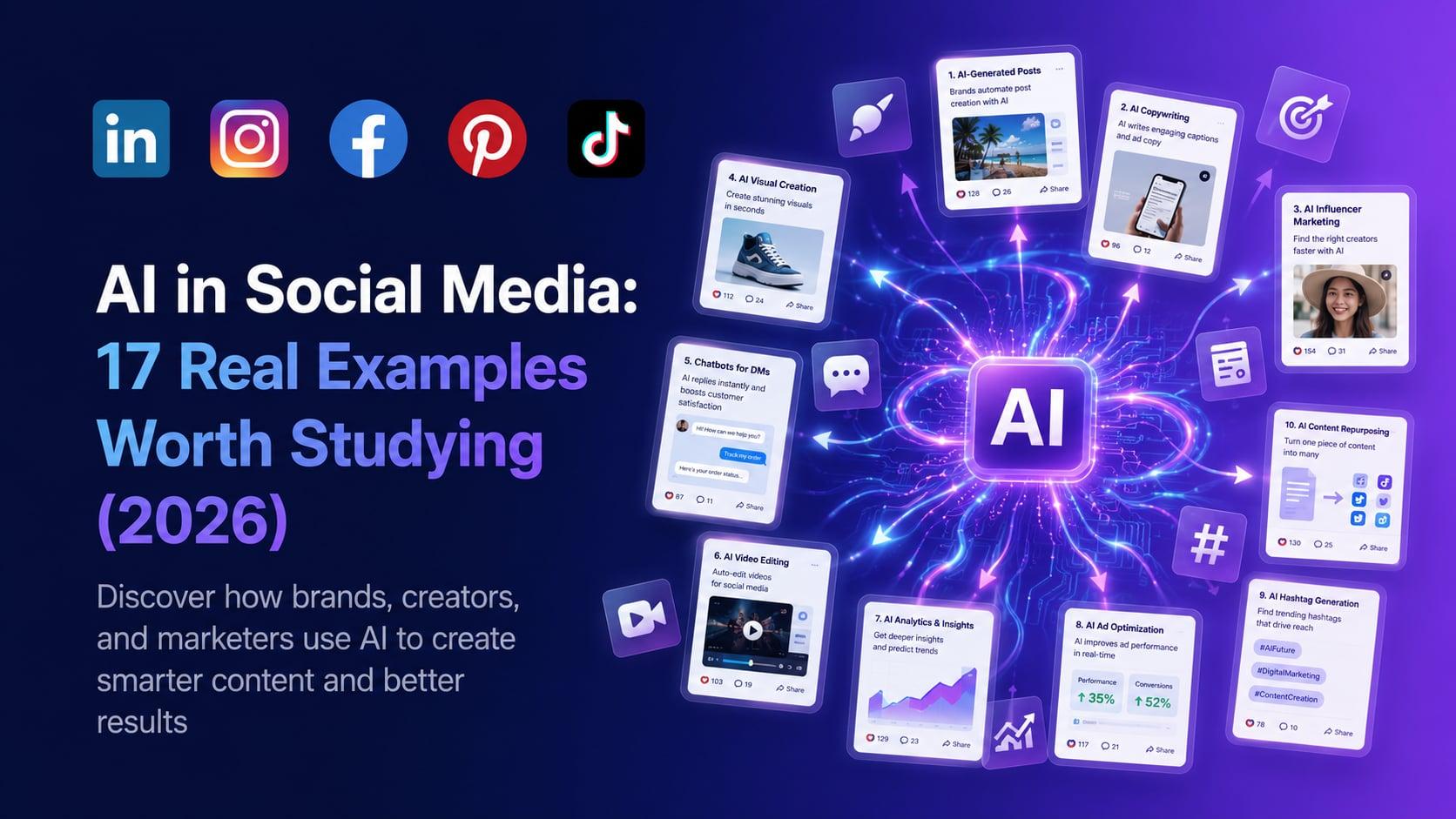
If you have spent any time on LinkedIn or Instagram in the last twelve months, you have seen AI-generated content. Most of it is mediocre. Some of it is excellent. Almost none of it is what people imagine when they hear "AI in social media."
This post is a tour of how AI is actually being used on social platforms in 2026 — across content generation, scheduling, targeting, image creation, and analytics. The goal is to give you a working map so you can identify what to copy, what to ignore, and where AI is genuinely changing the game.
1. AI-generated text posts (the obvious one)
This is what most people mean when they say "AI in social media." A founder or marketer types a prompt into a tool, and out comes a LinkedIn post or an Instagram caption.
What works: AI is excellent at generating a first draft. It eliminates the blank page, suggests structural patterns (hook, body, CTA), and handles platform-specific formatting like LinkedIn line breaks or Instagram emoji placement. Teams using AI as a first-draft engine consistently report 5-10x faster posting cadence.
What does not work: Raw, unedited AI output. Anyone reading social media regularly can spot it within two lines. The tells are predictable: opening with "In today's fast-paced world", overuse of em-dashes, generic CTAs like "What are your thoughts?".
Real example: A SaaS founder using an AI LinkedIn post generator drafts five posts in fifteen minutes, then spends another fifteen editing each to add a personal anecdote. The final posts read as 100% human because the human anecdote anchors the AI structure.
2. AI image generation for posts
Tools that turn a text prompt into a usable social-media image are now mainstream. The 2026 winners are Midjourney V8 for stylized work, Google's Gemini 3 Pro Image for photo-realism with text rendering, and integrated tools like aipost.social for on-brand consistency.
What works: Hero images for blog-share posts, illustrative graphics for explainers, consistent visual styles across a content series. AI is also strong for things that are tedious to source — flat-lay product mockups, abstract backgrounds, illustrated icon sets.
What does not work: AI images for product photography (you can spot it), faces (still imperfect in some platforms), and anything that needs precise text layout without explicit text-rendering models.
Real example: A creator runs a daily "Founder Lessons" series on LinkedIn. Each post uses the same illustrated character in a different scenario, generated via a consistent style prompt. The visual continuity drives recognition; the AI generation makes the series sustainable.
3. AI video and Reels generation
This is the fastest-growing AI category in 2026. Tools like Sora 2, Runway Gen-4, and Google Veo 3 can turn a script or even a still image into a 15-30 second video clip.
What works: B-roll generation for voiceover content, abstract visual loops for music or quote posts, "explainer" animations that would have required a motion designer. Multi-image-to-video pipelines (used inside aipost.social) generate consistent character animations across multiple shots.
What does not work: Anything requiring continuity of physical action (a person walking across a room), product demonstrations, or content that needs to look unmistakably real.
4. AI scheduling and post-timing
Less glamorous but arguably more impactful: AI that learns your audience's behavior and schedules posts when they are most likely to engage. Buffer, Later, and aipost.social all do this. The 2026 versions are far better than the rule-of-thumb suggestions from 2022 ("post at 9 AM Tuesday").
What works: Adapting to audience time zones, post-type recency (don't post two videos back-to-back), and platform-specific quirks (Instagram penalizes back-to-back link drops in stories).
5. AI hashtag and keyword research
Every serious creator-tool has this now. The AI looks at your post content, your past performance, and current platform trends, then suggests hashtags or keywords that are both relevant and not over-saturated.
Real example: A B2B SaaS company found that switching from generic hashtags (#marketing, #business) to AI-suggested niche hashtags (#productledgrowth, #b2bcontent) doubled their average post impressions on LinkedIn within a month — despite using fewer hashtags overall.
6. AI comment moderation
For accounts with active comment sections, AI now handles 80%+ of comment moderation. Spam, abuse, off-topic noise — all filtered automatically. The remaining 20% are flagged for human review.
7. AI-generated carousels
Instagram and LinkedIn carousels are one of the highest-engagement formats and one of the most time-consuming to make. AI carousel generators turn a single post idea into 5-10 cohesively-designed slides with consistent typography, color, and narrative pacing.
What works: Educational content series, "this vs that" comparisons, step-by-step walkthroughs. The AI handles the design system; the human handles the substance.
8. AI brand voice fine-tuning
The biggest leap in 2026: AI tools that can be trained on a brand's existing content (past LinkedIn posts, blog articles, customer support replies) and write new content in that voice. Done well, this eliminates the "this sounds like ChatGPT" problem entirely.
Real example: A consulting firm trained an AI on three years of their CEO's LinkedIn posts. The new AI-drafted posts now mimic her sentence rhythm, vocabulary preferences, and analogy style closely enough that her audience cannot tell the difference. She still reviews and approves every post.
9. AI-driven audience research
Tools that scrape and analyze the comments, posts, and DMs of an audience to surface what they actually care about. Output is usually a list of pain points, jargon, and topic gaps — fuel for human-written content.
10. AI repurposing across platforms
Take a long-form blog post, a podcast episode, or a webinar — feed it to an AI repurposing tool, and get a LinkedIn post, an Instagram carousel, three tweets, and a TikTok script. Done well, this is one of the highest ROI uses of AI in social media in 2026.
What works: Source content with strong opinions and specific examples. The AI extracts the most quotable lines and reformats them for each platform.
What does not work: Generic source material in, generic platform-specific posts out. Garbage in, garbage out applies absolutely.
11. AI personalization in DMs
This is the dark side. Tools that send "personalized" outreach DMs at scale. When done with care (small lists, real research), it works. When done at scale (the LinkedIn DM spam epidemic), it is the reason people are increasingly suspicious of any cold outreach.
12. AI-generated user-generated-content (UGC) ads
Tools that generate fake-looking-real UGC video ads for TikTok and Instagram. Controversial — and increasingly being labeled as AI by both platforms.
13. AI translation and localization
A creator records one video in English; AI tools generate lip-synced versions in 12 languages with native-sounding voiceovers. MrBeast pioneered this at scale in 2023. By 2026 it is mainstream and increasingly invisible.
14. AI thumbnail generation
For YouTube, TikTok, and Pinterest, thumbnails determine click-through rates more than content. AI thumbnail generators iterate on dozens of variants and A/B test them automatically.
15. AI-driven content calendars
Instead of you planning a week of posts, you give the AI a content pillar and a posting cadence; it generates a 30-day calendar of post ideas, ranked by predicted engagement. You approve, edit, or reject each one.
16. AI-powered analytics narratives
Instead of staring at a dashboard, you get a weekly written summary: "Your engagement is up 23%. Your three best-performing posts were all educational carousels posted on Tuesday. Your worst-performing format this week was promotional video. Recommendation: skip promotional video next week and double your Tuesday carousel cadence."
17. AI for social listening
Tools that monitor mentions of your brand, your competitors, and your category across every platform — then surface the conversations that matter. The 2026 versions can detect sentiment, identify emerging trends weeks before they peak, and suggest content responses.
The pattern across all 17
Look at this list closely. The AI uses that work have a few things in common:
- They eliminate friction, not judgement. AI handles formatting, drafting, scheduling, research. Humans handle taste, opinion, and strategy.
- They are platform-specific. Generic AI tools generate generic content. The wins come from AI that understands what works on LinkedIn vs Instagram vs TikTok vs Pinterest.
- They compound. Each use of a well-tuned AI tool makes the next use easier (better brand voice training, better hashtag intelligence, better scheduling).
That is the actual story of AI in social media in 2026: a quiet, compounding productivity multiplier for people who know what they want to say. Not a magic content machine for people who do not.
Next steps
If you want to start using AI for social media without the trial and error, aipost.social covers most of the categories above in one tool — post generation, image generation, video pipelines, hashtag research, scheduling, and brand voice fine-tuning.
Or, if you want to dig deeper, see:
Generate your own AI social media posts
aipost.social writes posts for LinkedIn, Instagram, Facebook, TikTok and Pinterest in seconds. Try the live demo — no signup required.
Try the live demo